KS2 grammar and punctuation worksheet that helps Year 3 and Year 4 children turn adjectives into adverbs by adding ly.
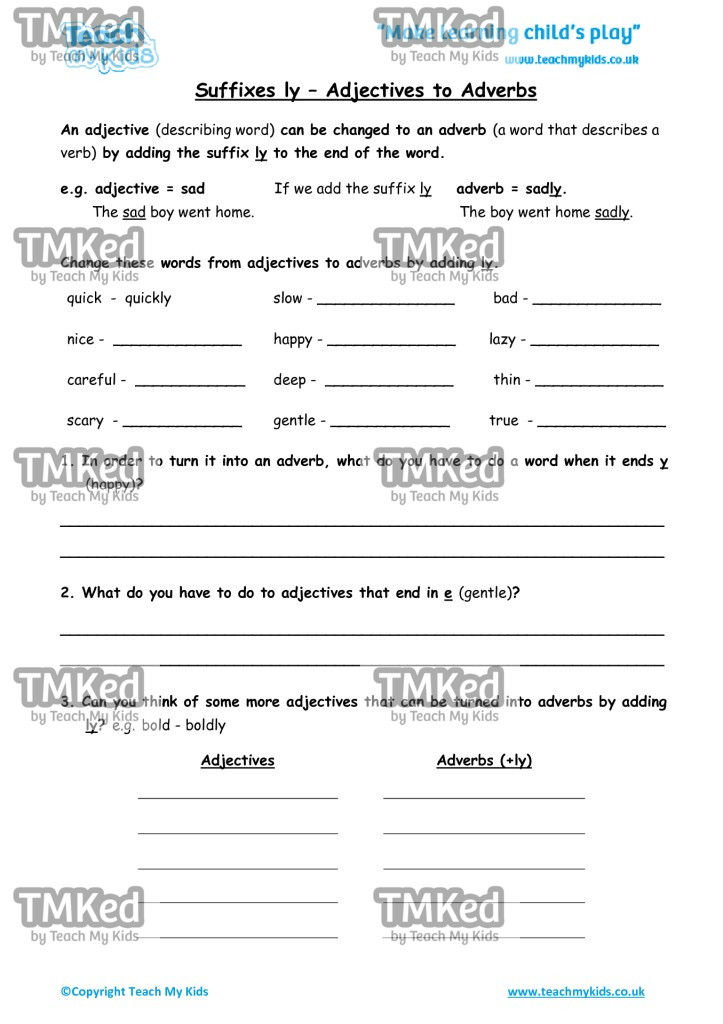
A short rule shows that adding ly to an adjective changes it into an adverb, with quick becoming quickly and a worked sentence pair using sad and sadly. Children change twelve adjectives to adverbs by adding ly: quick, slow, bad, nice, happy, lazy, careful, deep, thin, scary, gentle and true. Two follow-up questions ask them to explain the spelling rule for adjectives ending in y (such as happy) and for adjectives ending in e (such as gentle). To finish, they think of more adjectives that can be turned into adverbs.
Useful for KS2 SATs revision, classroom intervention or homework on word classes. See related work in our spelling and punctuation worksheets for KS2 ages 7 to 9. Printable PDF, A4, downloads instantly after purchase.