First Things First: Is Your Child Ready for Long Division?
Before you begin, it’s important to check if your child has the right foundation. Long division builds on several other maths skills and jumping in too early can lead to unnecessary frustration. Children learn at different speeds, some are quick to pick up skills and methods, others take a little longer. Forcing children to learn a concept when they are not ready can lead to unnecessary frustration for both the child and parent. Don’t be scared to go back a step or two before moving forward.
A child who is ready for long division should have:
- Strong multiplication skills: They should be confident with their times tables up to 12 x 12.
- Confident subtraction: They need to be able to subtract multi-digit numbers accurately.
- A solid grasp of basic division: They should understand the concept of division as ‘sharing’ or ‘grouping’.
In the Primary National Curriculum, long division is typically introduced in upper Key Stage 2 (Years 5 and 6). If you find your child struggling with the basics, pause and solidify those foundational skills first. This preparation is the key to teaching long division successfully.
Decoding the Lingo: The Parts of a Long Division Problem
Using correct mathematical terms helps avoid confusion. Before tackling the method, introduce your child to the components of a division problem. The analogy of sharing sweets can make these terms easier to understand:
- Dividend: The total number of items to be shared (e.g., 125 sweets).
- Divisor: The number of groups you are sharing into (e.g., 5 friends).
- Quotient: The answer, or how many items each group gets (e.g., 25 sweets each).
- Remainder: The items ‘left over’ that cannot be shared equally (e.g., leftover sweets).
The Secret Weapon: A 5-Step Method for Teaching Long Division
The biggest challenge in long division is remembering the sequence of steps. A simple mnemonic can help. Here’s one you could use, the ‘family’ method: Dad, Mom, Sister, Brother, Rover. Each family member represents one step in the process.
Step 1: D – Divide
Look at the first part of your dividend and divide it by the divisor. Ask: ‘How many times does the divisor fit into this number?’
Step 2: M – Multiply
Multiply the number you just got in the divide step (your partial quotient) by the divisor.
Step 3: S – Subtract
Subtract the result from the multiplication step from the part of the dividend you are working with.
Step 4: B – Bring Down
Bring down the next digit from the dividend and place it next to your subtraction answer. This creates the new number to work with.
Step 5: R – Repeat or Remainder
Now, you either repeat the entire process from Step 1 with the new number or, if it is smaller than the divisor, it becomes your remainder.
Let’s Solve One Together: A Step-by-Step Walkthrough
Let’s put the family method into practice. A clear, step-by-step example is essential for teaching long division at home. We will solve 457 ÷ 3 using a formal written method format:
First:
- Write your sum out using the formal written method (sometimes called ‘bus stop’)
- Divide: How many times does 3 go into 4? It goes in 1 time. Write ‘1’ on the answer line above the 4.
- Multiply: 1 x 3 = 3. Write ‘3’ under the 4.
- Subtract: 4 – 3 = 1. Write ‘1’ below the 3.
- Bring Down: Bring down the next digit, 5. Place it next to the 1 to make the number 15.
- Repeat: Start the process again with the new number, 15.
Next:
- Divide: How many times does 3 go into 15? It goes in 5 times. Write ‘5’ on the answer line above the 5.
- Multiply: 5 x 3 = 15. Write ’15’ under the 15.
- Subtract: 15 – 15 = 0. Write ‘0’ below.
- Bring Down: Bring down the next digit, 7. Place it next to the 0 to make the number 7.
- Repeat: Start again with the new number, 7.
Finally:
- Divide: How many times does 3 go into 7? It goes in 2 times (since 2 x 3 = 6). Write ‘2’ on the answer line above the 7.
- Multiply: 2 x 3 = 6. Write ‘6’ under the 7.
- Subtract: 7 – 6 = 1. Write ‘1’ below.
- Bring Down: There are no more numbers to bring down.
- Remainder: The number left, 1, is smaller than the divisor, 3. This is our remainder.
The final answer is 152 with a remainder of 1, written as 152 r 1.
Top Tips for Tear-Free Teaching
If your child is struggling, these practical strategies can build confidence and reduce frustration. This is essential for effective maths homework help.
Use Graph Paper
A common mistake is misaligning numbers. Using squared maths paper helps your child keep hundreds, tens, and units in the correct columns, making the process tidier and less prone to errors.
Start with Stories
Make maths relatable by framing problems in real-world scenarios. For example: ‘We have 130 stickers to share among 4 party bags. How many will go in each bag, and will any be left for you?’ This helps them understand the ‘why’ behind the method.
Praise the Process, Not Just the Answer
Focus on effort and strategy. Acknowledge when they follow a step correctly, even if a small calculation error leads to the wrong final answer. Saying, ‘I love how you remembered to bring down the next number!’ builds resilience and a growth mindset.
Take Breaks
If you see frustration building in you or your child, stop. It is far more productive to take a 10-minute break and return with a fresh mind. Pushing through tears is rarely effective.
Put It Into Practice with Our Expert-Designed Worksheets
Consistent practice is the best way to make the long division steps feel automatic. Once your child understands the method, our worksheets are the perfect next step for consolidating their skills.
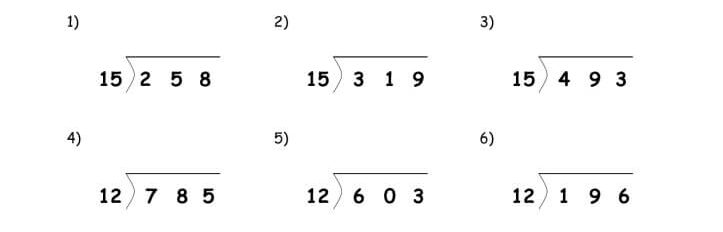
Designed by education experts, these resources offer scaffolded difficulty, clear layouts, and a mix of problems with and without remainders, all aligned with the primary school curriculum. Give your child the practice they need to become a confident divider.
Download Your Key Stage 2 Long Division Worksheets Here!
Conclusion: Building Maths Confidence, One Step at a Time
Teaching long division doesn’t have to be a stressful experience. By ensuring your child is ready, using clear language, and employing a memorable method like Dad, Mom, Sister, Brother, Rover, you can make this topic manageable. With patience and the right strategies, you can guide your child to success and give their numeracy skills a powerful boost.
Frequently Asked Questions (FAQ)
What’s the difference between short division and long division?
Short division, often called the ‘bus stop method’, is used for dividing by a single-digit number (e.g., 84 ÷ 4), where most of the calculation is done mentally. Long division is a more formal written method for dividing by two-digit numbers or larger (e.g., 572 ÷ 11), where every step is written down to keep track of the process.
My child gets the steps mixed up. What should I do?
This is very common! Have them write the mnemonic (DMSBR) at the top of their page. After they complete each action, they can tick the corresponding letter. This visual checklist helps them track their place in the cycle and builds a consistent routine.
How do I explain what a ‘remainder’ is in a simple way?
Use a concrete, relatable example. Say, ‘Imagine we have 13 cookies to share equally among 4 friends. Each friend gets 3 cookies (4 x 3 = 12), but there is 1 cookie left over. We can’t split it without breaking it. That 1 leftover cookie is the remainder.’