
Published: 12 March 2026
TL;DR:
Learn how to use short, focused KS2 grammar worksheets to build stronger sentences, clearer paragraphs and more confident extended writing in line with the Primary National Curriculum English.
KS2 grammar worksheets improve writing when you keep each sheet short, focus on one grammar idea, then use that idea straight away in sentences, paragraphs and longer pieces. When you link spelling, grammar and punctuation practice to real writing, you build clearer, more confident KS2 writers.
Have you ever finished a grammar lesson, then seen none of it in your pupils’ stories? The gap between a neat worksheet and a messy page of writing can feel huge, but you can close it with a simple step-by-step plan.
Reading & Writing Development Through Grammar.
How Can KS2 Grammar Worksheets Improve Writing Quality?
Grammar is how words fit together in sentences. Punctuation is the set of marks you add, like commas and full stops, to show pauses and meaning. When children in KS2 understand both, they read harder texts more easily and write with much more control.
Related: How do I help my KS2 class write better paragraphs for KS2 writing development?
Short, focused KS2 grammar worksheets help you teach one small skill at a time, such as fronted adverbials or verb tenses. When children then use that skill in their own sentences, their writing becomes clearer and more connected.
TMKed offers Primary National Curriculum English worksheets that match KS2 grammar objectives, so you can pick tasks that fit your current unit instead of starting from scratch. You can move from quick grammar practice to stronger stories, reports and explanations.
Take a look at Teach My Kids offering english worksheets that are age appropriate and organised in a ready to use way.
Why does grammar matter so much for KS2 reading and writing?
Grammar matters because the Primary National Curriculum English for Years 3 to 6 expects children to use a wide range of sentence types, correct verb tenses and accurate punctuation, including commas, speech marks and apostrophes.
Strong grammar knowledge supports reading comprehension. Comprehension means understanding what you read. When children know about clauses, which are parts of a sentence that contain a verb, they can untangle long sentences in stories and information texts.
For writing development KS2, grammar supports:
- Accuracy: correct tense and subject–verb agreement
- Sentence variety: simple, compound and complex sentences
- Clear paragraphs: ideas grouped in a logical order
- Cohesion: sentences that link well using conjunctions and adverbials
As children master small grammar skills through worksheets, they feel safer to try longer sentences and more detailed ideas, because they know how to control them.
What makes an effective KS2 grammar worksheet?
Effective KS2 grammar worksheets match the age group, use clear examples and build skills step by step. They differ from random literacy worksheets for children because they follow Primary National Curriculum English objectives for each year group.
Teach My Kids (our sister website) offers english worksheets that are age appropriate and organised in a ready to use way.
Related: How do I support KS1 spelling using phonics and spelling worksheets?
Good worksheets save you planning time and make it easy to see what you are teaching and why.
How should KS2 grammar worksheets link to the Primary National Curriculum?
The best KS2 grammar worksheets focus on one clear objective, such as:
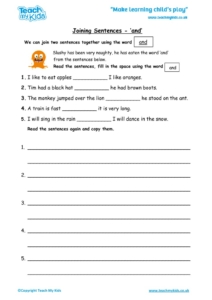
- Using conjunctions to join clauses, for example because, although, when
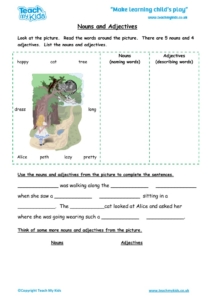
- Building expanded noun phrases, for example the dark, scary forest
- Adding fronted adverbials, which are words or phrases at the start of a sentence that tell you when, where or how something happens, for example Before sunrise, the birds began to sing
- Writing direct speech with correct punctuation
- Choosing the right verb tense and staying consistent
Each worksheet should state the matching curriculum objective so you can link it to your lesson plan or assessment notes.
Why should KS2 grammar worksheets be short and easy to differentiate?
Short tasks that last 5 to 10 minutes work well as lesson starters, quick checks, homework or small group work. Children focus better on one idea and you see gaps more clearly.
You can differentiate one worksheet by:
- Adding sentence starters or word banks for children who need more support
- Setting a challenge box with harder questions for confident writers
- Asking greater depth writers to write extra sentences using the same skill
How do you move from spotting grammar to using it?
An effective worksheet moves from recognition to application. Recognition means spotting a feature, such as underlining all the conjunctions. Application means using that feature in your own writing.
Strong teaching materials KS2 grammar often include:
Related: What KS2 spelling strategies make weekly routines stick?
- Model sentences to copy and adapt
- Guided examples with one part filled in
- Space for children to write their own sentences
How do you move from isolated grammar tasks to better KS2 writing?
You move from single grammar questions to better writing by following a simple pattern: practise the skill, use it in sentences, build a paragraph, then use it in a full piece.
Grammar flow:
Worksheet → Better sentences → Strong paragraphs → Full composition
Step 1: How do you practise one clear grammar focus?
First, pick one focus, for example subordinating conjunctions like because or although. Subordinating conjunctions join a main clause to a clause that depends on it, for example I went inside because it started to rain.
- Explain and model 2 or 3 examples on the board
- Talk through one question from the worksheet
- Let children finish the short KS2 grammar worksheet independently
Step 2: How do you apply the skill in improved sentences?
Next, use a quick sentence-improvement task. For example, start with:
“The dog barked.”
Ask pupils to improve it using the same grammar feature:
- With a conjunction: The dog barked because the stranger opened the gate.
- With a fronted adverbial: Without warning the dog barked at the stranger.
You can do this on mini whiteboards with the whole class or in a small tutoring group.
Step 3: How do you build short paragraphs using the new grammar?
Now ask children to write a 3 to 5 sentence paragraph that must include the target grammar a set number of times, for example three subordinating conjunctions.
Related: Grammar Workbook 2 (9-11 Years)
Link this to reading by showing a short text and asking pupils to spot the same feature, then copy the pattern in their own paragraph. This helps them see how grammar choices make a paragraph flow.
Step 4: How do you integrate grammar skills into longer writing?
Plan a longer piece, such as a story opening or a report. Choose 1 or 2 grammar focuses from recent KS2 grammar worksheets and turn them into success criteria, for example:
- Use at least three fronted adverbials
- Use two complex sentences with subordinating conjunctions
Ask pupils to self or peer edit by underlining where they used the target grammar and improving one or two weak sentences.
How can TMKed KS2 grammar worksheets support classroom and home learning?
TMKed KS2 grammar worksheets are ready to print and follow the Primary National Curriculum English. They save you planning and marking time because each sheet has clear questions and answers.
Teachers, teaching assistants, tutors and parents can slot them into existing units or home learning plans without changing everything.
What are some ideas for classroom use of KS2 grammar worksheets?
You can use KS2 grammar and punctuation worksheets in several ways:
Related: Grammar Workbook 2 (7-9 Years)
- Daily warm ups before writing lessons
- Targeted intervention with small groups who need extra support
- Literacy centres linked to guided reading texts
For example, if your reading text uses lots of speech, choose a worksheet on direct speech and then ask pupils to add dialogue to a scene.
How can parents and tutors use grammar worksheets at home?
For home learning, aim for short, regular practice rather than long sessions.
- Use one short worksheet two or three times a week
- After each sheet, give a simple writing prompt, such as “Describe your dream pet using three expanded noun phrases”
- Follow the answer sheet so you feel sure about spelling, grammar and punctuation
How do grammar worksheets connect to wider English skills?
You can link grammar tasks to spelling and vocabulary by choosing word lists that fit the same text type, for example powerful verbs for adventure stories. You can also pair grammar sheets with reading comprehension questions that use the same sentence patterns.
TMKed offers English and maths educational worksheets and workbooks across EYFS, KS1 and KS2, so you can keep a similar style of practice as children move through the school.
FAQ: What do teachers and parents ask about KS2 grammar worksheets?
This section answers common questions about how to use grammar worksheets to improve KS2 writing.
How often should children use KS2 grammar worksheets?
Use KS2 grammar worksheets little and often, for example 2 to 4 short tasks per week. This keeps skills fresh without overloading children.
Can grammar worksheets really improve creative writing?
Yes, when you follow them with sentence, paragraph and full writing tasks. The worksheet gives the building blocks, and the follow up writing lets children use those blocks in creative ways.
Related: Grammar Workbook 1 (9-11 Years)
How do I support mixed-ability groups with the same worksheet?
For mixed-ability groups, you can:
- Offer oral rehearsal before writing, where pupils say sentences out loud
- Give sentence starters or word banks to some pupils
- Add challenge questions or extra sentences for confident writers
What if I am not confident teaching grammar as a parent or carer?
If you do not feel confident with grammar, choose worksheets with clear examples, simple language and full answer sheets. TMKed resources guide you step by step so you and your child learn together.
Conclusion: What are your next steps for using KS2 grammar worksheets effectively?
Targeted KS2 grammar worksheets build sentence control, cohesion and clarity when you link them directly to real writing, not just test-style questions. The simple pattern is: practise a feature, improve sentences, build paragraphs, then use the skill in full compositions.
Your next step is to look at your current planning and pick one or two grammar focuses to develop this term. Then choose TMKed printable, curriculum-based grammar worksheets and workbooks to support KS2 learners in class and at home.
Frequently asked questions
Reading & Writing Development Through Grammar: How Can KS2 Grammar Worksheets Improve Writing Quality?
Grammar is how words fit together in sentences. Punctuation is the set of marks you add, like commas and full stops, to show pauses and meaning. When children in KS2 understand both, they read harder texts more easily and write with much more control.
Why does grammar matter so much for KS2 reading and writing?
Grammar matters because the Primary National Curriculum English for Years 3 to 6 expects children to use a wide range of sentence types, correct verb tenses and accurate punctuation, including commas, speech marks and apostrophes.
What makes an effective KS2 grammar worksheet?
Effective KS2 grammar worksheets match the age group, use clear examples and build skills step by step. They differ from random literacy worksheets for children because they follow Primary National Curriculum English objectives for each year group.
How should KS2 grammar worksheets link to the Primary National Curriculum?
The best KS2 grammar worksheets focus on one clear objective, such as:
Why should KS2 grammar worksheets be short and easy to differentiate?
Short tasks that last 5 to 10 minutes work well as lesson starters, quick checks, homework or small group work. Children focus better on one idea and you see gaps more clearly.
How do you move from spotting grammar to using it?
An effective worksheet moves from recognition to application. Recognition means spotting a feature, such as underlining all the conjunctions. Application means using that feature in your own writing.
How do you move from isolated grammar tasks to better KS2 writing?
You move from single grammar questions to better writing by following a simple pattern: practise the skill, use it in sentences, build a paragraph, then use it in a full piece.